

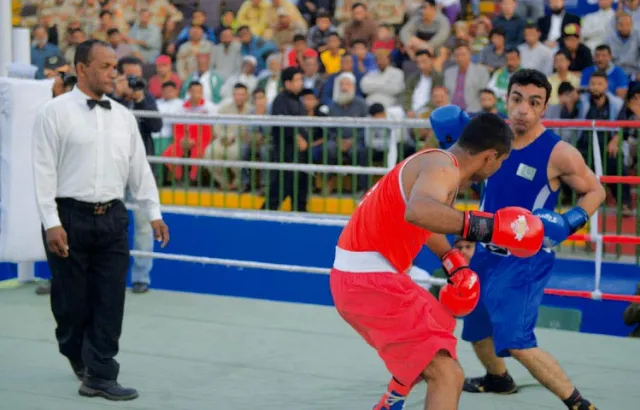
Boxing arrived in Lyari before Pakistan did. Ustad Mohammad Sattoo — known in the neighborhood as Baba-e-Boxing, the Father of Boxing — established the Lyari Labour Welfare Centre Boxing Club in 1940, seven years before partition. The club’s roots extend further: Sattoo began organizing the sport informally as early as 1918, inspired by boxing clubs he encountered while working as a cargo ship laborer traveling the world. African immigrants who settled along Karachi’s waterfront introduced the sport to the area, and it took hold among the predominantly Baloch working-class residents of a neighborhood built by dockworkers, fishermen, and daily-wage laborers.
That founding history matters because it explains something about Lyari’s relationship to boxing that no government policy created and no official body could replicate. The sport became embedded in the neighborhood’s identity across generations, sustained by community structures rather than state support, long before it produced champions.
The Neighborhood’s Geography of Sport
Lyari is located in Karachi’s southwest, a densely populated area of narrow lanes near the port. Its residents have historically been among the city’s most economically marginal — the people who built Karachi’s commercial infrastructure without sharing proportionally in its returns. Football and boxing became the neighborhood’s two dominant sports partly for practical reasons: both require minimal equipment to begin and can be practiced in the kind of compressed urban space Lyari offers. Kakri Ground, formerly known as Muhammad Ali Jauhar Park, served for decades as the neighborhood’s main outdoor sports venue, used simultaneously for football, boxing practice, political rallies, and weddings—a measure of how densely Lyari packs its functions.
By the time a Dawn survey in the early 2000s mapped Karachi’s affiliated boxing clubs, 12 of the city’s 13 clubs in the southern district were located in Lyari. That concentration was not accidental. It reflected eight decades of accumulated infrastructure—not always formal infrastructure, but the kind built through coaches passing knowledge to fighters who became coaches themselves, and clubs founded on small pieces of land with minimal equipment and maximum community investment.
What the Neighborhood Produced
The most famous product of Lyari’s boxing culture is Hussain Shah, who won Pakistan’s only Olympic boxing medal at the 1988 Seoul Games after training on the neighborhood streets, using garbage bags stuffed with sand as punching bags. His story — homeless child to Olympic medalist — became the founding myth of Pakistani boxing, the proof of concept that Lyari’s talent, given any opening at all, could compete at the world’s highest levels.
The Qambrani family extended that legacy into an institution. Muhammad Siddique Qambrani, whose grandfather was an early pioneer of boxing in the neighborhood and a founder of the Muslim Azad Boxing Club, competed at the 1970 Asian Games in Bangkok. His son, Ali Mohammad Qambrani, was a member of the national squad from 1990 to 1999, won gold at the 1995 Asian Boxing Championships in Manila, and was considered one of the best prospects of his generation before his death at Lyari General Hospital in October 2009 at the age of 40. Family members have served in multiple roles—as coaches, referees, and administrators—sustaining boxing in Lyari for decades despite minimal external support.
Younus Qambrani, who founded the Pak Shaheen Boxing Club in Lyari in 1992, further extended that family tradition. In 2013, he decided to begin training girls at the club, a move his peers in the boxing community initially mocked as impractical in a conservative neighborhood. He proceeded anyway. Girls from the club have since competed in national competitions, and Pak Shaheen has become one of the first clubs in the country to train female boxers systematically. His daughter Anum Qambrani summarized the logic plainly: “My two uncles are international boxers and my father is a coach. Boxing is in our blood.”
The Gang War Years
Between roughly 2008 and 2013, Lyari descended into sustained gang warfare that killed hundreds of residents and turned sections of the neighborhood into genuine no-go zones. Schools closed for extended periods. Women couldn’t move freely to markets. The violence reached its peak under the criminal network led by Uzair Jan Baloch before state operations beginning in 2012 gradually restored a measure of order.
Boxing clubs did not shut down entirely during those years, but the violence’s effect on the sport was measurable. Training became dangerous to travel to. Events that required gathering crowds became untenable in neighborhoods where public spaces were contested. The loss of Anwar Chaudhry — the Lyari-connected Pakistani sports official who served five consecutive terms as president of the International Boxing Association and was boxing’s most influential international advocate — to death in 2010 removed the sport’s most effective external patron just as the neighborhood crisis deepened. Younus Qambrani later described Chaudhry’s absence as leaving Pakistani boxing without its only real benefactor.
Lyari After the Violence
The neighborhood has stabilized significantly since the mid-2010s. Rangers-led operations dismantled the major gang networks. Kakri Ground underwent a substantial renovation, completed in 2023 under a joint Sindh government-World Bank project, transforming what had been a dust-covered multipurpose field into a modern sports complex with a football turf, a boxing arena, an indoor gymnasium, and facilities designated for female athletes. The arena was named the Ustad Ali Muhammad Qambrani Boxing Arena — another acknowledgment of the family whose contributions shaped what boxing in the neighborhood became.
The boxing clubs are running again. Razia Bano, who began training in Lyari after watching interviews with local boxers following Muhammad Ali’s death in 2016, became Pakistan’s first female amateur boxer to win national gold in the flyweight category. Her path from watching television to national champion followed a chain of inspiration that runs directly back to what Mohammad Sattoo built in 1918.
Fighters from across Pakistan who reach the national level still tend to pass through Lyari’s boxing culture at some point — through the clubs, through coaches connected to the neighborhood’s lineage, or through the informal networks that make Lyari the center of gravity in Pakistani boxing even when other cities produce talented individual fighters. That position was not granted by officials or constructed by policy. It was built by working-class families who treated boxing as something worth sustaining across generations, regardless of what the government did or didn’t provide.
