

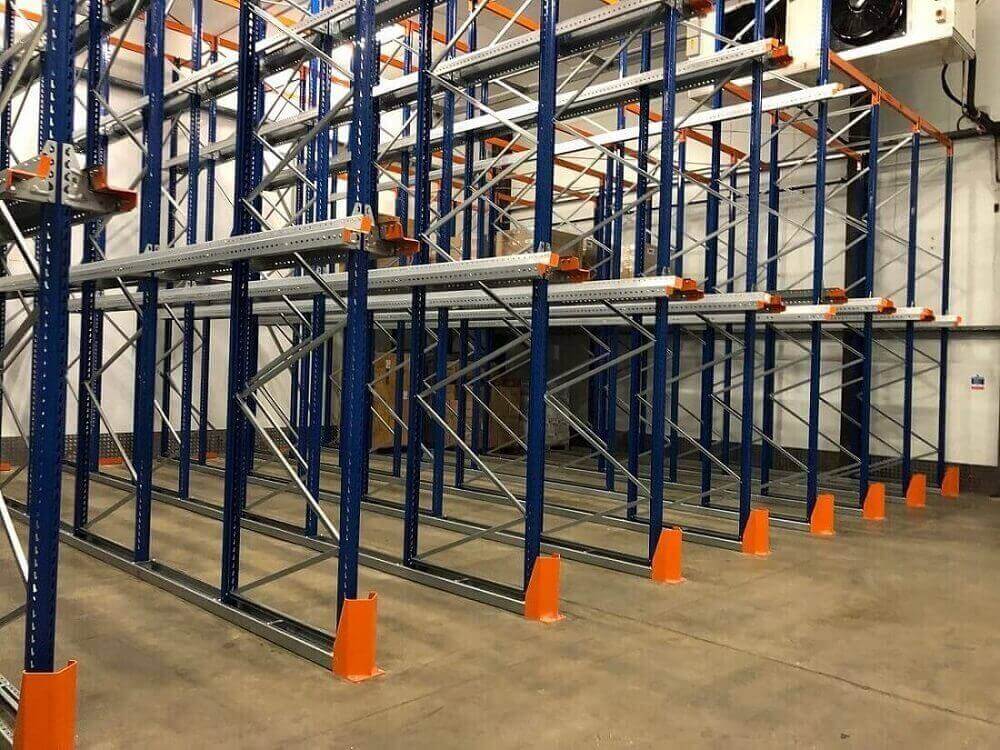
The drive-in pallet racking system presents itself as a study in spatial efficiency, a solution born from the perpetual warehouse manager’s dilemma of fitting more into less. Stand at the entrance of a facility employing this configuration, and you observe not rows of individually accessible pallets but rather deep lanes, tunnels of steel extending backward into the building’s interior, each capable of holding five, six, perhaps ten pallets in succession. The forklift operator, in a manoeuvre requiring both skill and nerve, drives directly into these corridors, threading between vertical uprights with minimal clearance on either side, to deposit or retrieve loads deep within the structure.
The Fundamental Architecture
The construction logic of drive-in pallet racking system differs fundamentally from conventional selective systems. Where standard racking provides individual bay access, drive-in configurations sacrifice this immediacy for density. The framework consists of upright columns connected by horizontal rails, creating a continuous structure rather than separate units. Pallets rest upon these rails, cantilevered out from the uprights, with no beams beneath blocking the pathway.
Picture the system as a series of bridges. Each rail functions as a narrow span, supporting concentrated weight at specific points. The forklift enters at ground level, deposits its load, then reverses out along the same path. Upper levels require the operator to elevate the load, drive forward to the desired depth, raise the forks above the rail height, deposit the pallet, and retreat. In Singapore’s temperature-controlled facilities, where every cubic metre of chilled space carries operational costs, this vertical and horizontal density justifies the additional handling complexity.
Operational Advantages
The benefits of implementing a drive-in storage system become apparent through simple mathematics. Traditional selective racking might achieve storage density of 500 to 600 pallet positions per thousand square metres. Drive-in configurations routinely exceed 900 positions in the same footprint, an increase approaching 50%. For operations storing homogeneous products in quantity, the economic argument proves compelling.
Consider these specific advantages:
- Elimination of multiple aisles reduces wasted floor space substantially
- Ideal for storing large quantities of identical SKUs
- Protection from environmental exposure as pallets nest within the structure
- Reduced refrigeration costs in cold storage applications through higher density
- Lower building costs per stored unit due to maximised utilisation
A logistics coordinator at a Singapore distribution centre observes, “When storing 200 pallets of the same beverage SKU, selective racking makes little sense. We load them ten deep in drive-in lanes, and they move out in reverse order as orders arrive. The density allows us to hold two months’ inventory in half the space.”
Inherent Limitations and Constraints
Yet the drive-in pallet racking methodology imposes constraints that render it unsuitable for many applications. The system operates on last-in, first-out principles. The most recently stored pallet occupies the lane entrance, while earlier loads sit progressively deeper. Retrieving these rear pallets requires first removing everything in front, a significant operational burden for fast-moving diverse inventory.
The structural vulnerabilities merit attention. Forklift impacts on uprights occur with troubling frequency. An operator misjudging lateral clearance by mere centimetres can strike a column, potentially compromising the entire lane’s integrity. Unlike selective racking where damaged uprights affect only immediate bays, drive-in damage may necessitate evacuating entire lanes.
Load specifications require careful adherence:
- Typical load limits range from 1,000 to 1,500 kilograms per pallet position
- All pallets within a lane must maintain uniform dimensions
- Height clearances demand precision, typically 150 to 200 millimetres between pallet and upper rail
- Floor flatness specifications exceed those for standard racking
Optimal Application Scenarios
Certain industries and operations align naturally with drive-in racking infrastructure. Cold storage facilities represent perhaps the ideal application. When storing frozen seafood, frozen vegetables, or temperature-sensitive pharmaceuticals, the products remain stable for extended periods. Stock rotation matters less than density, and the cost per pallet position including refrigeration drops significantly.
Manufacturing operations maintaining raw material buffers also benefit. A plastics manufacturer receiving regular shipments of identical resin pellets can efficiently store 50 pallets deep, drawing from the front as production demands. The predictable consumption pattern matches the system’s retrieval limitations.
“In our cold chain facility,” notes one operations manager, “the refrigeration savings alone justify the system. We calculate approximately 35% reduction in cooling costs per stored unit compared to our previous selective racking layout.”
Installation and Safety Considerations
Proper implementation of drive-in pallet storage demands rigorous attention to installation standards. Floor surveys must confirm adequate load-bearing capacity and flatness tolerances. The concentrated weight of fully loaded lanes, combined with the absence of distributed aisles, creates higher point loads than selective systems.
Safety protocols require:
- Regular structural inspections focusing on upright integrity
- Clear signage indicating load limits and lane depths
- Operator training specific to drive-in navigation
- Adequate lighting within lanes for depth perception
- Impact protection on entry uprights
The drive-through variant, where forklifts can enter from either end, offers improved stock rotation by enabling first-in, first-out operation. This configuration suits operations receiving and dispatching from opposite sides of the warehouse, though it requires access aisles on both ends, slightly reducing density advantages.
The warehouse designer selecting a drive-in pallet racking system must weigh density gains against operational constraints, matching system capabilities to actual storage patterns and retrieval requirements.
