

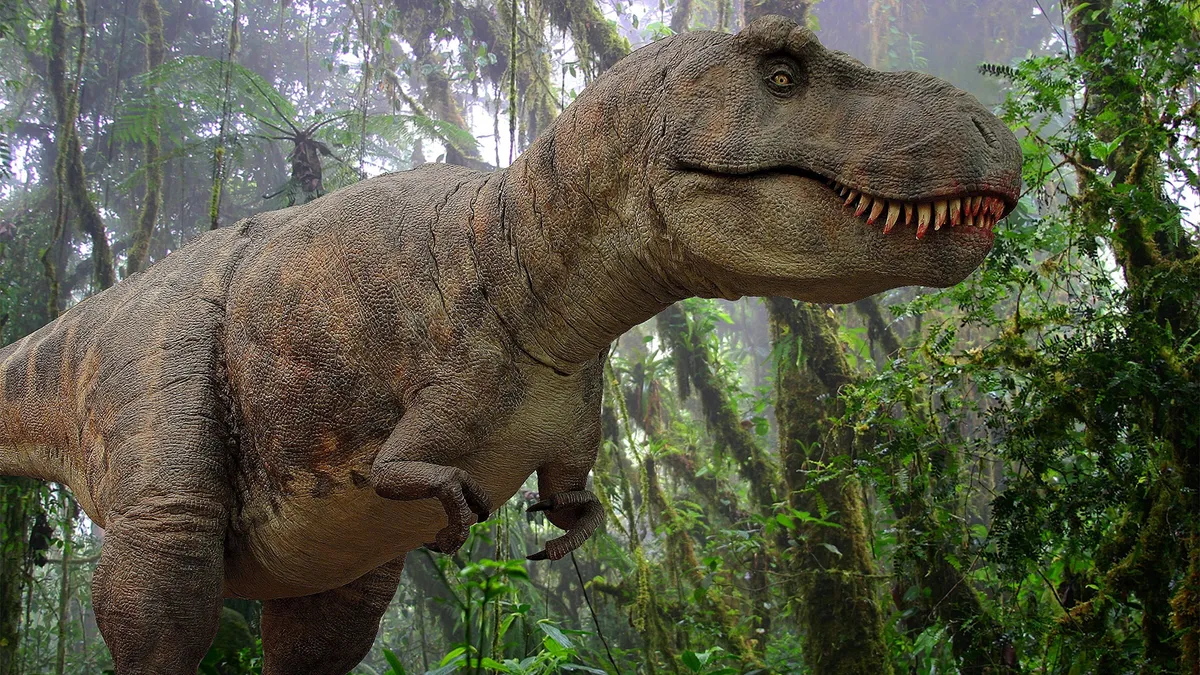
Episode 9 of The Story of Life on Earth follows a single Tyrannosaurus rex through one day in the Late Cretaceous, from a morning hunt to an uneasy night. Far above it, the asteroid that will end the age of dinosaurs is already on its way.
Waking in a Cretaceous Forest
The episode opens on an eye roughly the size of an orange. It blinks open in a humid forest where sunlight breaks through the canopy, and the animal it belongs to draws a slow breath. This is Tyrannosaurus rex, 68 million years ago, in what is now western North America. A large adult could weigh up to about nine tons, stand nearly thirteen feet tall at the hip, and stretch around forty feet from snout to tail.
Instead of surveying the whole Cretaceous period, the episode spends a single day with one T. rex and sees its world from the ground. The kingdom this animal rules has a clock running. Somewhere beyond the atmosphere, an asteroid is already on a collision course with Earth.
A Body Built for the Hunt
The day begins with hunger. T. rex was an apex predator, built for hunting and likely for scavenging as well. Its brain was shaped differently from a mammal’s, but it had very large olfactory lobes, the regions that process smell. In a dense, subtropical forest where sightlines were short, a strong sense of smell would have been a real advantage.
Its eyes faced forward more than those of many other dinosaurs. That gave it good binocular vision, and with it the depth perception needed to judge the distance to a moving target. On this morning the target is a herd of Edmontosaurus, large duck-billed herbivores stripping leaves from the undergrowth. An Edmontosaurus could have several hundred teeth packed into a dental battery, with new teeth replacing worn ones as it ate. The result was a grinding mill for fibrous plants.
- Rex was not a long-distance runner. Its most likely strategy was an ambush, or a short and forceful pursuit. In the episode it moves through cycads and ferns until the herd startles, then closes in on a juvenile lagging behind the others.
The hunt ends quickly and the episode keeps the moment brief. The weapon that made it possible was the bite. Estimates of T. rex bite force start at nearly 8,000 pounds-force, and a 2012 computer-modeling study by Karl Bates and Peter Falkingham put the upper end at nearly 13,000 pounds-force, enough to crush bone. In the Hell Creek Formation, the rock layers of Montana and the Dakotas that preserve this ecosystem, that was simply how the food web worked.
A Greenhouse World Split in Two
While the T. rex feeds, the episode pulls back to the wider planet. Late Cretaceous Earth ran hot and humid. Volcanic activity helped push carbon dioxide well above today’s levels, and neither pole held permanent ice. With that water in the oceans instead of locked in ice sheets, sea levels at their peak stood roughly 170 meters (more than 500 feet) higher than they do now.
North America was not a single continent. A broad, shallow sea called the Western Interior Seaway ran from the Gulf of Mexico toward the Arctic and divided the land in two. T. rex lived on the western landmass, which paleontologists call Laramidia, while an eastern landmass called Appalachia lay across the water. The two halves developed separate dinosaur communities over millions of years.
The T. rex habitat was a patchwork of humid river valleys and coastal forests, and it was a world in bloom. Flowering plants, or angiosperms, had appeared somewhere around 140 to 130 million years ago and by the end of the Cretaceous had become the dominant plant group in most land ecosystems. They grew alongside older forests of conifers, ferns, and cycads. This mix of vegetation supported a wide range of plant-eating dinosaurs, and those plant-eaters were the food supply that made a predator of T. rex’s size possible.
Rivals and an Open Question
A fresh carcass draws attention. In the episode a second Tyrannosaurus appears at the edge of the clearing, and the scene opens one of the live debates in paleontology. Whether T. rex lived alone or in groups is unknown. Several fossil sites preserve more than one tyrannosaur buried together, which could point to group living. Bones can collect in one place for other reasons too, so the evidence is suggestive rather than settled.
Fighting is better documented. Some skulls of T. rex and related tyrannosaurs bear tooth marks and healed scars left by other tyrannosaurs, so fights between them clearly happened. The prize might have been a carcass, a territory, or a mate. The episode imagines the two animals circling and issuing low booming sounds, while noting plainly that nobody knows what a T. rex actually sounded like.
The scene also turns to the famous arms. Each ended in two claws, and although they look small against the body, they were strongly built. Nobody has settled what they were for. One proposal is that they held on to prey trying to break free. Another is that they helped the animal lever itself up after lying down. The real weapons were the head and jaws. After a tense standoff, the smaller rival backs away.
Triceratops and the Real Hell Creek Neighbors
Later in the day, the T. rex meets Triceratops, one of the most common large dinosaurs in its region. First named by Othniel Charles Marsh in 1889, an adult Triceratops could reach about nine meters long and weigh around ten tons. Triceratops bones scored with T. rex tooth marks have been found, and some of those wounds had healed, so at least a few Triceratops were attacked while alive and lived through it. In the episode this one holds its ground, and the T. rex moves on to save its energy for easier prey.
The episode then corrects a common picture from films. Velociraptor, a turkey-sized feathered predator known from Mongolia’s Gobi Desert, lived several million years earlier and on another continent. Spinosaurus, the sail-backed predator from Cretaceous North Africa, had been extinct for tens of millions of years before T. rex appeared.
The animals that did share its world are known from Hell Creek itself. Herds of Edmontosaurus moved through the forests. Ankylosaurus and its relatives were low, heavily armored plant-eaters covered in bony plates, with a club at the end of the tail.
Giant pterosaurs flew over Laramidia, among them Quetzalcoatlus, whose fossils come from farther south in Texas rather than from Hell Creek itself, with a wingspan comparable to a small airplane. In the seaway to the east, mosasaurs were the top marine predators. For the last couple of million years of the Cretaceous, T. rex held the top position on land in western North America.
A New Light in the Sky
At dusk, the episode imagines the T. rex calling out across the floodplain, a sound carrying a long way. The call is dramatization. It marks the animal’s place at the top of a food web shaped by over 150 million years of dinosaur evolution. Then night falls, and a bright new point of light hangs in the sky. It has grown a little brighter each night. That detail is invented for the story too, and it sets up the turn the episode has been building toward.
The Chicxulub Impact and the End of the Dinosaurs
About 66 million years ago, an asteroid roughly six to nine miles wide hit shallow water off what is now Mexico’s Yucatán Peninsula. The Chicxulub crater it left is more than 110 miles across, and the energy released matched millions of nuclear weapons. The blast wave was superheated and moved outward at more than a thousand kilometers per hour. Earthquakes shook the region and enormous tsunamis swept the coastlines.
Trillions of tons of vaporized rock and debris were thrown into the atmosphere. As it fell back, it may have heated the air enough to start widespread wildfires. The longer damage came from dust and soot. They blocked sunlight, possibly for months or years, and the result was an impact winter. Temperatures fell, photosynthesis collapsed, and food chains built on plants failed from the bottom up.
The evidence for this story was assembled over decades. In 1980, Luis and Walter Alvarez, Frank Asaro, and Helen Michel reported unusually high levels of iridium, an element rare in Earth’s crust but common in asteroids, in a thin clay layer at the Cretaceous-Paleogene boundary near Gubbio, Italy. The crater itself had been detected in 1978 during oil surveys, and its identity as an impact structure was confirmed in 1991.
There was a second suspect. At around the same time, eruptions in what is now western India were building the Deccan Traps, lava flows that today cover roughly 500,000 square kilometers. They released large volumes of sulfur and carbon dioxide. Paleontologist Gerta Keller has long argued that the eruptions were destabilizing ecosystems well before the impact. How much the volcanoes contributed is still debated, but most researchers now treat the asteroid as the main trigger, with volcanism possibly adding stress beforehand.
Around 75 percent of all species disappeared, including T. rex and every other non-avian dinosaur.
Echoes Today
In the quiet world that followed, a few groups survived, among them small mammals that included our own distant ancestors. Dinosaurs had existed for roughly 165 million years and were the dominant large land animals for most of that span, and T. rex was among the last of them.
Their line did not end, though. Birds are theropod dinosaurs, and a pigeon on a city street belongs to the same broad lineage as Tyrannosaurus. Today there are roughly 10,000 to 11,000 living bird species, more than the approximately 6,800 recognized mammal species. The flowering plants that spread through the T. rex’s forests now make up the large majority of living plant species, including the crops that feed people.
The Chicxulub case also shows how a scientific consensus forms, with an iridium spike in Italian clay and a buried crater in Mexico each making the other harder to dismiss. Some biologists argue that today’s species losses, driven by human activity, amount to a sixth mass extinction, and they measure the rate against this one.
Watch next. Episode 10, After the Dinosaurs, follows the survivors into an emptied world and the rise of the mammals.
The Story of Life on Earth is an independent, unofficial documentary series built from original research. It is not affiliated with any publisher, author, or existing book or series.
