

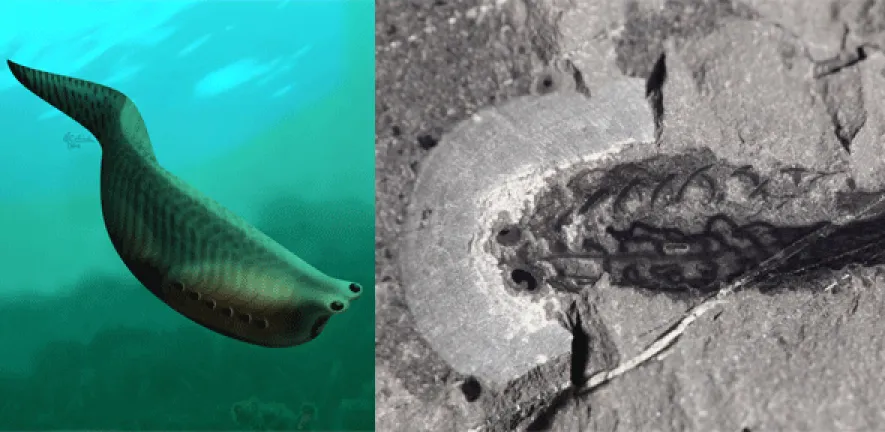
By around 485 million years ago, the ocean Episode 4 of “The First Spark” left behind had grown crowded. Trilobites, brachiopods, and early cephalopods filled warm, oxygen-rich seas, and the first true vertebrates swam among them. None of those early vertebrates could bite anything. For roughly 100 million years, they could only suck, filter, or scrape. Their mouths had no hinge and no way to close on prey.
Sacabambaspis shows how limited that stretch really was. An armored, jawless fish from roughly 470 million years ago, known from Ordovician rock in Bolivia and Oman, it fed through a mouth ringed by close to 60 small bony plates. Those plates could shift in and out to expand and contract its throat. That motion drew food in by suction rather than biting down. It’s a workable way to eat. It is not the way a predator eats.
Episode 5 picks up the moment that changed, when a piece of anatomy built for breathing became a weapon.
The Bone That Became a Bite
The leading explanation for how jaws appeared is also one of the oldest ideas in vertebrate biology, dating back to the late 1800s: a gill arch, one of the bony hoops that braces the gills and lets a fish breathe, hinged forward and turned into the first jaw. The theory fell in and out of favor for over a century, partly because no direct fossil showed the transition step by step.
Developmental biology has since given the old idea new support. Researchers studying zebrafish and skates found that the pseudobranch, a vestigial gill-like structure tucked behind a fish’s jaw, develops from the same mandibular arch that forms the jaw itself. Both structures rely on overlapping genetic programming. That shared origin is strong circumstantial evidence that jaws and gills are, structurally speaking, variations on the same theme, exactly what the century-old gill arch hypothesis predicted before anyone could test it at the molecular level.
Whatever the exact mechanism, jawed fish start showing up in the fossil record in meaningful numbers by the Silurian period. Once that hinge existed, it reorganized the entire food chain built on top of it.
Prey that had only ever faced suction and scraping now faced something that could clamp down and hold on. The same evolutionary pressure that had produced compound eyes and grasping limbs earlier in the Cambrian arrived again, this time built around a hinge instead of a claw.
A Fossil That Rewrote the Family Tree
For years, paleontologists assumed the earliest jawed vertebrates looked something like a shark: a flexible, cartilaginous skeleton with no true bones in the face, and jaws built from a small number of simple elements. A 2013 discovery upended that picture.
Paleontologist Min Zhu and colleagues described Entelognathus primordialis, a 20-centimeter fish recovered from the Kuanti Formation near Qujing, in China’s Yunnan Province, dated to roughly 419 million years ago at the close of the Silurian period. Entelognathus wore the bony armor plating typical of placoderms, the first major group of jawed fish, but its face carried something no placoderm was supposed to have: distinct premaxilla, maxilla, and dentary bones, the same dermal jaw bones found in modern bony fish and, eventually, in every land vertebrate including humans. The find suggested that complex, bony jaw architecture isn’t a later invention layered on top of a simpler ancestral jaw. It may be closer to the ancestral condition itself, present from very near the root of the jawed vertebrate family tree.
From Bottom Feeders to Ocean Giants
Placoderms, the group Entelognathus belonged to, spread widely once jaws existed. Some stayed small, armored bottom feeders scraping food off the seafloor. Others grew into the largest, most heavily armored predators the ocean had yet produced. The biggest was Dunkleosteus, a placoderm that could reach roughly 6 meters long and had no teeth in the conventional sense.
Bothriolepis sat at the opposite end of that range. Found across Devonian rock on nearly every continent between roughly 387 and 360 million years ago, it grew to a modest size and kept small jaws and teeth. It spent its life along the bottom, working invertebrates out of the mud rather than chasing anything down. Its head and thorax were sealed in heavy bone; the rear half of its body carried no armor. Between an animal like that and something the size of Dunkleosteus, placoderms had found nearly every way a jawed fish could make a living in a Devonian sea.
A Bite Built Like Self-Sharpening Blades
Instead of teeth, Dunkleosteus’s jaws were lined with hardened bony plates shaped into fangs and slicing edges. As the upper and lower plates closed, they sheared against each other, continually renewing their own cutting edge with every bite, a built-in sharpening mechanism no living animal still uses in quite the same way.
Biomechanics researchers Philip Anderson and Mark Westneat modeled the bite of one large specimen and found forces of roughly 4,400 newtons at the jaw’s rear cusps and up to 5,300 newtons at the cutting tip, translating to pressures around 21,000 pounds per square inch at the blade’s edge, in the range of a modern crocodile’s bite. A predator with that kind of bite could crush shelled ammonites and even the armor of other placoderms. It was one of the first true apex predators in vertebrate history.
The Shark That Still Carried Armor
Sharks and their relatives, the chondrichthyans, took a different path than placoderms. Their skeletons remained mostly cartilage rather than bone. One of the earliest and best-preserved chondrichthyan fossils, Doliodus problematicus, dates to roughly 409 million years ago in the Early Devonian rocks of New Brunswick, Canada. Found in 1997 and eventually described from a nearly complete specimen, Doliodus preserves shark-like tooth families still arranged in their original rows in the jaw, along with something unexpected: paired spines at the base of its pectoral fins, a hardened feature previously known only from armored fish like placoderms, not from any cartilaginous fish before or since.
Doliodus sits close to the split between sharks and the rest of the jawed vertebrate lineage, and its mix of shark-like teeth and placoderm-like fin spines suggests that armor and cartilage weren’t yet locked into the separate evolutionary paths they’d eventually take. Before this specimen was fully described, the oldest confirmed chondrichthyan remains were mostly isolated teeth and fin spines, fragments that left plenty of room to argue about what the earliest sharks actually looked like. A nearly complete body pinned that question down considerably.
Two Extinctions and What Outlasted Them
Placoderms didn’t survive to see any of that resolved. Two extinction pulses closed out the Devonian period: the Kellwasser event, roughly 372 million years ago, killed off around half of all placoderm families, mostly smaller, species-poor, bottom-feeding groups. Thirteen million years later, the Hangenberg event, at the very end of the Devonian around 359 million years ago, finished the job, and placoderms disappeared from the fossil record entirely.
Sharks survived both extinctions and are still here today. Their skeletons didn’t sit still for 400 million years, though. Living cartilaginous fish have changed considerably in body shape, size, and behavior since the Devonian, even as cartilage itself has remained their skeleton’s defining material generation after generation. The underlying architecture survived, the same one first tested inside a bent gill arch a few tens of millions of years earlier.
What the Jaw Set in Motion
Not every jawless lineage disappeared once jaws took over. Lampreys and hagfish, both still alive today, descend from branches of the vertebrate family tree that split off before that gill arch ever hinged forward, and they still feed now much as their ancestors did long before Dunkleosteus or Entelognathus existed.
The gill arch that hinged forward in some other jawless ancestor didn’t just add a new body part. It rewrote what a predator could be, from Dunkleosteus’s self-sharpening blades to the jaw bones still recognizable in Entelognathus’s 419-million-year-old face, and eventually to every hinged jaw alive today, including the one reading these words.
