

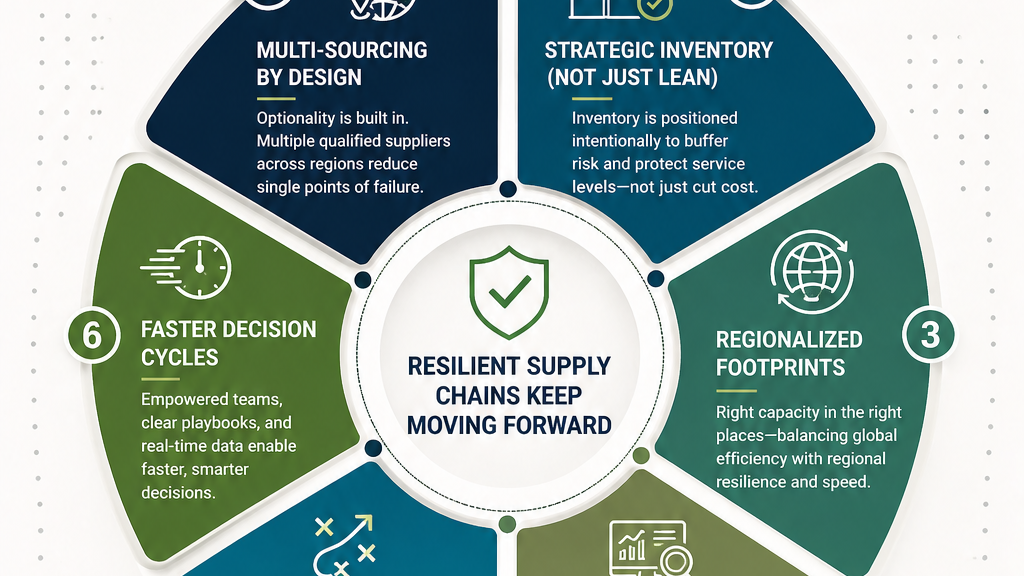
Businesses need reliable supplies, but holding excessive inventory ties up capital and creates storage, damage and obsolescence risks. The challenge is to build resilience without filling warehouses with stock that may never be sold.
A resilient supply chain is not defined by having the largest inventory buffer. It is defined by the ability to identify disruption early, respond quickly and continue serving important customers.
Map the full supply chain
Start by identifying the suppliers, locations, transport routes and systems that support each important product or service. Many businesses understand their direct suppliers but have limited visibility beyond them.
Map:
- Critical materials
- Key suppliers
- Secondary suppliers
- Manufacturing locations
- Warehouses
- Transport routes
- Payment dependencies
- Technology platforms
- Regulatory requirements
This map can reveal concentration risk. A business may appear to have several suppliers, but they may all depend on the same factory, port or raw material.
Classify items by importance
Not every item deserves the same level of protection. Segment products according to customer impact, revenue, margin, replacement difficulty and lead time.
Critical items may require:
- More frequent supplier reviews
- Backup sourcing
- Safety stock
- Faster escalation
- Alternative specifications
Less important items may be managed through standard purchasing rules. Segmentation allows the business to spend resilience resources where they matter most.
Improve demand visibility
Excess inventory often comes from poor demand information. Businesses may order too much because forecasts are unreliable, or too little because sales and operations work from different assumptions.
Improve visibility by connecting:
- Sales forecasts
- Customer orders
- Promotional plans
- Seasonal patterns
- Inventory levels
- Supplier lead times
- Production capacity
Forecasts should be updated when new information becomes available. A plan created months ago may not reflect current customer behaviour.
Use targeted inventory buffers
Safety stock should be based on risk rather than a fixed percentage applied to every item. Consider lead-time variability, demand uncertainty and the cost of a stockout.
A larger buffer may be justified when:
- The item is difficult to replace
- Customers face serious disruption
- Lead times are long
- Demand is volatile
- The supplier has limited capacity
For low-value or easily available items, excess stock may create more cost than protection.
Develop alternative suppliers
Supplier diversification can reduce dependency, but adding more suppliers creates management and quality-control work. Businesses should prioritise critical categories rather than trying to duplicate every purchase.
Evaluate:
- Geographic location
- Production capacity
- Financial stability
- Quality performance
- Compliance
- Lead times
- Ability to scale
- Communication
A backup supplier should be tested before an emergency. A name on a spreadsheet is not the same as an operational alternative.
Build supplier relationships
Resilience improves when suppliers share information early. Regular conversations can reveal capacity constraints, material shortages or planned changes before they affect delivery.
Discuss:
- Forecasts
- Lead times
- Minimum order quantities
- Capacity
- Quality trends
- Upcoming shutdowns
- Alternative materials
- Recovery plans
Strong relationships do not remove the need for contracts and monitoring. They improve the speed and quality of information.
Review product specifications
Overly specific product requirements can make replacement difficult. Where appropriate, engineering and procurement teams should identify approved alternatives.
This may involve:
- More than one material specification
- Compatible component options
- Standardised packaging
- Multiple delivery methods
- Alternative production locations
Any substitute should be tested for quality, safety and customer expectations before it is approved.
Improve operational visibility
Technology can help teams see inventory, orders and supplier activity in one place. The goal is not to collect more data, but to make important information available early.
Useful indicators include:
- Supplier on-time delivery
- Lead-time changes
- Order confirmation delays
- Inventory coverage
- Demand variance
- Quality failures
- Port or transport disruption
- Unusual price movements
Alerts should be connected to clear responsibilities. Information without action does not create resilience.
Prepare response playbooks
A disruption is easier to manage when the business has already agreed on possible actions. Create playbooks for likely scenarios, such as supplier failure, transport delays or sudden demand.
Each playbook should identify:
- Trigger conditions
- Decision owners
- Customer communication
- Alternative suppliers
- Inventory priorities
- Financial authority
- Recovery steps
Test the plan through a short simulation. Exercises can expose unclear contacts and unrealistic assumptions.
Measure resilience performance
Resilience should be measured through operational outcomes, not only inventory levels.
Review:
- Time to detect disruption
- Time to recover
- Stockout frequency
- Supplier concentration
- Forecast accuracy
- Inventory turnover
- Customer service level
- Cost of emergency purchasing
A business that maintains service with less inventory may be improving, even if its warehouse stock falls.
Frequently asked questions
Does resilience require holding more inventory?
Not always. Supplier diversification, better visibility and faster response can provide protection without excessive stock.
How many suppliers should a business have?
There is no universal number. The right approach depends on product criticality, replacement difficulty and supplier concentration.
Should every supplier have a backup?
Prioritise the items and suppliers that could create the greatest customer or financial impact.
How often should supply-chain risks be reviewed?
Critical suppliers should be monitored continuously, with formal reviews at least quarterly.
Is local sourcing always safer?
Local sourcing may reduce transport risk, but it can still create concentration risk. Location should be evaluated alongside capacity and financial stability.
More Business Resources
- Operations Insight Hub – Practical ideas for improving business operations and workflow efficiency.
- Cash Flow Journal – Guidance on cash-flow planning, budgeting and financial control.
- Market Growth Review – Insights into marketing, customer demand and sustainable business growth.
- Leadership Pathways – Useful perspectives on leadership, decision-making and team management.
- Entrepreneurship Weekly – Practical advice for founders, startups and growing businesses.
- Supply Chain Today – Strategies for supplier management, logistics and operational resilience.
- Customer Experience Guide – Ideas for improving customer satisfaction, trust and retention.
- Workplace Productivity Hub – Practical methods for improving workplace productivity and efficiency.
- Business Finance Desk – Articles about pricing, profitability, payments and business finance.
- Small Business Resource – Helpful guidance for managing and expanding small businesses.
- Pricing Strategy Journal – Insights into pricing decisions, margins and customer value.
- People and Talent Review – Guidance on recruitment, employee development and retention.
- Business Innovation Network – Ideas for innovation, new services and competitive advantage.
- Ecommerce Business Guide – Practical advice for online selling, digital shops and ecommerce growth.
- Business Risk Monitor – Information on risk management, compliance and business continuity.
- Sales Performance Journal – Strategies for improving sales pipelines, conversions and client relationships.
- Flexible Work Review – Insights into hybrid work, remote teams and modern workplace policies.
- Sustainable Business Today – Practical approaches to energy efficiency, sustainability and responsible growth.
- Business Planning Centre – Resources for business planning, forecasting and strategic decision-making.
- Workplace Culture Journal – Ideas for building stronger, healthier and more productive teams.
- Digital Business Review – Insights into digital transformation, technology adoption and business systems.
- Growth Strategy Journal – Practical strategies for entering new markets and scaling a company.
- Vendor Management Guide – Advice on supplier selection, contracts and vendor performance.
- Market Research Digest – Guidance on customer research, competitor analysis and market opportunities.
- Startup Strategy Hub – Useful ideas for launching, funding and developing a new business.
- Customer Retention Review – Strategies for loyalty, repeat purchases and long-term customer relationships.
- Payment Innovation Journal – Information about digital payments, real-time transactions and payment security.
- Business Continuity Desk – Practical planning for disruptions, emergencies and operational recovery.
- Investment Planning Review – Business-focused guidance on investment decisions, capital allocation and growth.
- Future Business Outlook – Perspectives on changing markets, emerging opportunities and the future of business.
